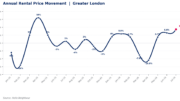


Benham and Reeves reveals London rents rose £936 in the year to September, with two boroughs topping £2,000 a month, after average monthly rents climbed 3.5 percent.
New analysis by Benham and Reeves, based on Office for National Statistics data, puts the London average at £2,338 a month, up from £2,260. That £78 monthly rise adds £936 to the annual cost of renting at the capital average, with 30 of 32 boroughs recording increases.
Rises on this scale tighten the maths for landlords as well as tenants. Higher achieved rents support cover on refinances, but the borough spread shows affordability pressure is uneven, and shrinking stock points to fewer available homes chasing steady demand.
Islington and Southwark lead rent rises
Islington recorded the largest cash increase. Average monthly rents rose by £179, adding £2,148 to the annual bill. Southwark saw the sharpest percentage rise at 7.3 percent, equal to £171 a month or £2,052 a year.
Other large increases included Hammersmith and Fulham at £1,620 on an annualised basis, Richmond upon Thames at £1,428, Merton at £1,380 and Greenwich at £1,368. Kensington and Chelsea, Wandsworth, Hackney, Brent and Enfield all recorded four-figure annual rises.
Only Kingston upon Thames and Westminster bucked the trend, with small annual falls of £96 and £144. Havering recorded the smallest rise among increasing boroughs at £168, followed by Bexley at £312 and Haringey at £348. The City of London was excluded for lack of data.
Supply squeeze sits behind higher bills
Zoopla September 2026 figures show rental availability across London down 6 percent year on year, with inner London down 13 percent. Rightmove third-quarter figures also point to fewer listings, with available rentals down 9 percent across the capital.
Marc von Grundherr, director of Benham and Reeves, said falling stock was feeding higher rents. “London rents have continued to climb over the last year, placing further financial pressure on tenants who are already contending with a high cost of living,” he said.
He said added regulation and tax risked pushing more landlords out. “If the Government genuinely wants to improve rental affordability, it needs to recognise that a healthy private rented sector depends on retaining existing landlords and encouraging further investment,” he said.
This follows Landlord Knowledge’s report on tribunal outcomes, which showed landlords keeping only 6.2 percent from 10 percent rent rise bids. The contrast is sharp: headline market rents keep rising while contested increases face close scrutiny.
Landlords weighing arrears risk alongside higher rents should also see Landlord Knowledge’s coverage of NRLA arrears data, which found arrears behind 53 percent of possession cases. Stronger rents do not remove the need for strict referencing.
The borough breakdown is set out in ONS private rents and house prices data for September 2026, the dataset behind the Benham and Reeves calculations.
What this means for landlords
- If you let in Islington, Southwark or west London: Market rents support higher asking levels, but document comparables carefully for any challenge.
- If you let in outer boroughs with smaller rises: Price to demand and void risk rather than the London average, as gaps between boroughs are wide.
- If you plan to expand: Falling listings point to less competition for stock but tougher affordability checks on tenants.
- Watch for: Stock levels into winter, arrears early warnings, and the effect of tax and regulatory costs on net income.
- Bottom line: Headline rents are up almost £1,000 a year, yet keeping that growth depends on tenant selection and evidence.
Editor’s view
London’s average hides the real story. Double the rise in some boroughs, almost flat elsewhere, and fewer homes to let. Landlords who price to the street, not the city, will keep voids down.
Author: Editorial Team – UK landlord & buy-to-let news, policy, and finance
Published: 20 November 2026
Sources: Benham and Reeves, ONS
Related reading: Hello Neighbour: landlords keep only 6.2% of 10% rent rises