
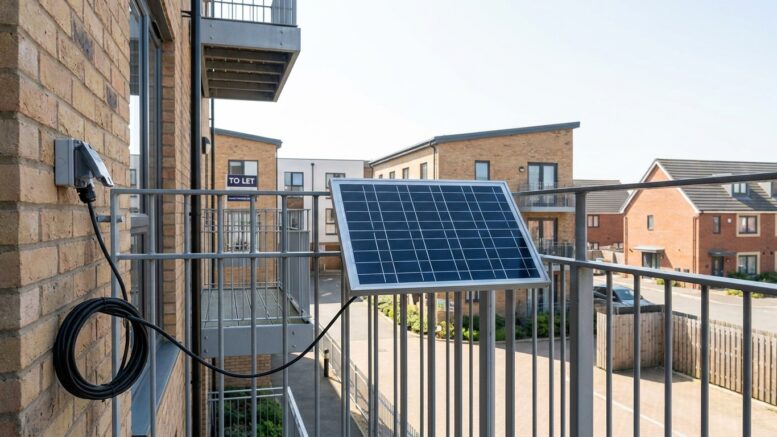
Plug-in solar panels can now be used legally in Great Britain, creating a new compliance issue for landlords whose tenants want cheaper power without waiting for a full roof-mounted installation.
The change took effect from 27 August, but Riskstop has now warned that the smaller systems should not be treated as a low-risk gadget simply because they plug into a standard socket. The risk specialist says landlords, freeholders and insurers may all need to pay closer attention as the products reach flats, balconies and rental homes that were never designed with on-site generation in mind.
Small balcony or terrace systems could arrive in the private rented sector quickly because they are far easier to install than conventional solar. That leaves landlords dealing with practical questions on consent, electrical safety, mounting, insurance and network notification before the technology becomes widespread.
Why plug-in solar changes the risk picture
Riskstop says plug-in photovoltaic systems differ from standard roof-mounted solar because they feed electricity into an existing socket circuit rather than being hard-wired into the building’s electrical distribution system. That means the condition of the existing installation, the compliance of the product and the safety protections built into the unit all matter from the start.
For rental homes, the issue is not just whether the panel works. A landlord may also need to consider whether the tenancy allows external alterations, whether a balcony or wall can take the mounting safely and whether the insurer expects to be told. In some cases a freeholder or managing agent may need to sign off changes before anything is fixed outside the flat.
This follows Landlord Knowledge’s report on March 2027 energy rules for new homes, which highlighted how landlords are being drawn into a wider shift in how homes use power, heating and low-carbon technology. Plug-in solar is a smaller step than a full retrofit, but it points in the same direction – more equipment, more checks and less room to ignore how a property’s electrical system is coping.
Landlords may need a policy before tenants ask
Landlords who wait until a tenant has already bought a kit may find themselves making rushed decisions. A clear written approach can cover whether permission is required, what evidence of product compliance is needed, who installs and maintains the system, and whether any balcony or external mounting will be allowed at all.
There is also a timing issue here. With the products only just becoming legal in Great Britain, the first wave of requests is likely to come before many landlords, agents or block managers have settled on a standard response. That could leave inconsistent decisions across portfolios and added friction in leasehold buildings.
Landlords already weighing broader upgrade plans may also want to read Landlord Knowledge’s recent coverage of HMO improvement spending, where energy and amenity works were already rising up the agenda. Plug-in solar may not suit every asset, but it adds another item to the list for owners trying to balance tenant expectations with compliance risk.
Riskstop’s bulletin says the exposure can still be managed proportionately, but only if owners understand what has been installed, where it has been positioned and how it is being maintained. The early lesson for landlords is simple: treat plug-in solar as electrical generation equipment, not as a harmless add-on.
What this means for landlords
- If you own flats or leasehold rentals: check whether tenant-installed panels would need landlord, freeholder or managing-agent consent before anything is mounted outside.
- If your property has an older electrical system: review whether a standard socket circuit is suitable before agreeing to any plug-in generation kit.
- Watch for: insurer questions, balcony mounting issues and any network-operator notification requirements as the products spread.
- Practical step: give agents a written position on plug-in solar now, so requests are handled consistently.
- Bottom line: the products are small, but the liability questions around them are not.
Editor’s view
Landlords do not need to panic about plug-in solar, but they do need to get ahead of it. The risk is not the technology itself so much as casual adoption in buildings where nobody has agreed the ground rules.
Author: Editorial Team – UK landlord & buy-to-let news, policy, and finance
Published: 3 September 2026
Sources: Riskstop
Related reading: Propertymark says March 2027 energy rules will reshape new rentals
🏠 EPC Rules for Landlords: What You Need to Know
Minimum EPC C required by 2030 – new assessment rules from late 2027