Last updated: 17 February 2026 - Links, enforcement statistics and guidance references updated.
Since 2016 all landlords in England have had rules imposed upon them which effectively make them unpaid supernumerary emigration control agents. The Right to Rent rules are complicated and subject to frequent change, and the potential penalties for failing to apply them are high.
What is Right to Rent?
Brought in on the back of the 2014 Immigration Act, the Right to Rent regulations are supposed to deter those who are illegally resident in the UK from remaining here. Unfortunately they also imposed considerable extra responsibilities on landlords in England. who are not required to check the immigration status of tenants.
The rules apply to residential tenancy agreements first entered into on or after 1 December 2014 in Birmingham, Wolverhampton, Dudley, Sandwell and Walsall, and on or after 1 February 2016 in the rest of England.
A landlord is not required to conduct right to rent checks in relation to tenancy agreements entered into before the dates set out above. Neither is he or she required to conduct such checks where existing tenants renew their tenancy without break after the dates set out above.
Neither are children covered by the right to rent rules; these apply to over-18s only.
What is required of landlords is set out in the Government guide Renting out your property. This points to the further and more specific guidance in Check your tenant’s right to rent.
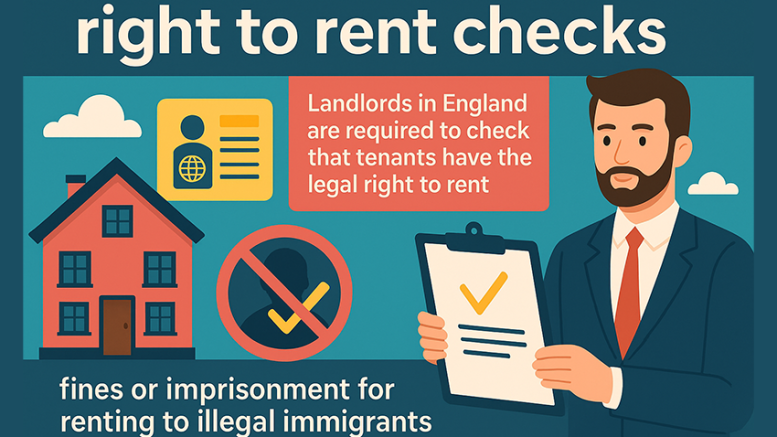
There is no need for landlords to check a tenant’s right to rent in Wales, Scotland or Northern Ireland. But landlords in England who fail to make right to rent checks leave themselves open to heavy fines and even the possibility of imprisonment – see Code of practice on right to rent: civil penalty scheme for landlords and their agents.
Despite warnings of the dire consequences for those who do not follow the rules, despite umpteen thousands of pounds, perhaps millions, spent by the Home Office in devising the rules and issuing frequently updated advice to landlords, agents and tenants on what they should do to comply, and despite the cost in time, energy and money to landlords, there is little evidence that right to rent requirements have had much effect on illegal immigration.
Enforcement has, however, ramped up significantly. Between late 2024 and October 2025, the Home Office issued 375 civil penalties for right to rent offences totalling £4.2 million-up from 235 penalties and £596,400 in the preceding period. Even so, landlords have no alternative but to comply with the law.
Who must be checked?
Check your tenant’s right to rent advises that, ‘before the start of a new tenancy’ landlords must check that all tenants aged 18 and over, have the right to rent. This applies even if they are not named in the tenancy agreement, if there is no tenancy agreement, or if the tenancy agreement is not in writing.
All new tenants must be checked. It is discriminatory and against the law to check only people the landlord thinks are not British citizens or on the basis of their name, religion or appearance may not have the right to be here.
Who has the right to rent?
The vast majority of potential tenants will have either an unlimited or a time limited right to rent.
Those having the right to rent include:
- British Citizens;
- Irish Citizens;
- People who have been granted permission to live in the UK, including those granted such permission through the EU Settlement Scheme, and no time limit has been imposed on their permission to stay;
- People with unexpired time limited permission to enter or stay in the UK, for example, time-limited permission under the points-based immigration system; and
- People with outstanding Home Office applications to settle in the UK.
A person is not permitted to occupy residential accommodation if they require permission to be in the UK and do not have it and do not have an outstanding application with the Home Office.
How to check right to rent online
View a tenant’s right to rent in England has an online checking service.
This must now be used to make right to rent checks on prospective tenants who hold an eVisa. It can also be used for prospective tenants who have biometric passports, residence cards or permits, have settled or pre-settled status; or have applied for a visa and used the UK Immigration: ID Check app to scan their identity document on their phone.
To access the online checking service, landlords will need the tenant’s date of birth and a 9-character ‘share code’ provided by the tenant. Tenants can obtain such a code via the government webpage Prove your right to rent in England.
Share codes are valid for 90 days from the point of issue and can be used as many times as needed within that time. But they may only be used for the purpose for which they were originally generated. In the case of proving right to rent status, this means the share code must begin with the letter ‘R’. Landlords may not accept or use of share codes which begin with the letter ‘W’ or ‘S’ as these designate other services.
Using Identity Service Providers
From April 2022, it has been acceptable for landlords use a certified Identity Service Provider (IDSP) to complete the digital identity verification element of right to rent checks for British and Irish citizens who hold a valid passport; this includes Irish passport cards. Dozens of providers are now certified-see the government’s list for current options.
Acceptable documents for manual checks
In some cases landlords can make the required checks by examining their tenant’s original documents.
The (considerable) list of which documents are acceptable as evidence of a right to rent are included in an annex to the Landlord’s guide to right to rent checks (updated July 2025). Which and how many documents are required vary according to circumstances, but it is only documents on this list that may be accepted.
To arm themselves with a ‘statutory excuse’, or valid defence against claims they have failed in their right to rent duties, landlords should make and keep copies of any documents that tenants provide.
How to verify documents
When making checks, and in the presence of their prospective tenants, Landlords should check that the:
- documents appear genuine;
- documents have not been tampered with;
- documents belong to the person presenting them;
- photographs and dates of birth seem to fit the person presenting them and lead to no suspicion of impersonation; and
- Immigration Permission to Enter or Stay in the UK has not expired.
If there is a difference in names, evidence should be provided by the prospective tenant of the change (for example through divorce, marriage, or change by deed-poll).
There is government Guidance on examining identity documents.
If a landlord or agent is given a false document, or a genuine document which is not the property of the person being checked, he or she should call the landlord helpline on: 0300 790 6268.
Keeping records
The landlord or agent must make clear copies of each document, in a format that cannot be altered. These copies must be kept securely, either electronically or as hardcopy format. A record of the date when the check was made must also be kept. As a date on the document could apply to anything, documents kept as evidence should be inscribed with: ‘the date on which this Right to Rent check was made’, followed by the date and the landlord’s or agent’s signature.
Landlords should copy and retain copies of passport pages with:
- expiry date of the document;
- nationality of the passport holder;
- date of birth;
- signature;
- biometric details;
- photograph;
- any page with information which would indicate the passport holder has permission to enter or stay in the UK, which could be a visa or entry stamp.
Follow-up checks
It is not only new tenants who must be checked. Inherited tenants and those whose status changes during the course of a tenancy may also be covered by the rules.
Checks must also be made on those tenants whose time-limited right to rent is due to expire during the tenancy.
The landlord should ask such tenants for proof of their continued right to rent. If this cannot be provided but the tenant claims a continued right to rent, the landlord must request a check via the Home Office Landlord Checking Service. Confirmation of continued right to rent relieves the landlord of further responsibility – until the next check is due.
Should the check result in notification that the tenant no longer has a right to rent, the landlord must make a report to the Home Office.
Such a report should also be made where checks undertaken by the landlord suggest the tenant no longer has a right to rent, and also if the tenant refuses to co-operate. This can be done using the Home Office reporting form ‘as soon as reasonably practicable’.
Selling property with sitting tenants
Where there is a sitting tenant and the landlord sells the property to a new owner, it is the duty of the new owner to check with the previous owner that right to rent checks have been conducted. Evidence of this should be provided and copies of relevant documents retained.
Careful note needs to be taken of the date that any follow-up checks are required. If these fall before the date of sale, the new owner will need assurance they have been undertaken; if after, the new landlord must make the checks him or herself.
An exception is made where a tenancy started before the right to rent regulations came into being, when the new landlord need not confirm with the old that a right to rent check was made. Even so, the new landlord should keep a record of when the tenancy was originally entered into (not least because it may be necessary in the event of eviction proceedings).
Landlords who sell property with sitting tenants who do not have the right to rent will be liable for penalties. This applies in circumstances in which, at the time the tenancy began, the tenant had a time-limited right to rent and no follow-up checks were conducted and the tenant’s right to rent had expired at the time of sale.
Using letting agents
Landlords who use letting agents can ask the agent to carry out checks on their behalf But this must be written into an agreement, making specific mention of the right to rent checks and that they must be done within 28 days prior to the tenancy start date. The landlord must be sure that the agent is fully competent to undertake these checks and be confident the agent will take full responsibility for follow-up checks if the tenant has a time-limited right to rent. This arrangement should be included in the agency agreement. If there is an agreement which clearly transfers liability for the right to rent checks from the landlord to the agent, then any liability for civil penalties transfers to the agent. Otherwise, it does not.
If an agent discovers that the prospective tenant does not have the right to rent, the landlord must be informed. In taking such action, the agent transfers responsibility for any penalties arising should the landlord decide to enter into an agreement with the tenant regardless.
Landlords or agents must not enter into a tenancy agreement with a prospective tenant until right to rent checks have been completed.
It is important that prospective and existing tenants understand their own responsibilities to provide documents, or where not available, provide acceptable alternative proof of their right to rent – such as that provided by the Home Office online service.
Avoiding discrimination
Landlords (and their agents) must not only comply with the legislation introduced by the Immigration Act 2014, but also the Equality Act of 2010. Government guidance on avoiding discrimination is included in Right to rent immigration checks: landlords’ code of practice.
Landlords should conduct right to rent checks in a fair, justifiable and consistent manner. The checks should apply to all prospective tenants. When checks are made, it would be helpful for those with poor English skills to be accompanied and advised by a third party such as a friend or family member, council or charity worker.
More information on avoiding discrimination is available in the Code of Practice for Landlords: Avoiding unlawful discrimination when conducting ‘right to rent’ checks in the private rented residential sector.
Penalties for non-compliance
As already mentioned, the penalties are harsh for landlords or agents, who let properties in breach of right to rent rules. In the most serious cases, involving repeated or deliberate failures, the penalty could be five year’s imprisonment and/or an unlimited fine. There are also fines if the landlord/agent simply cannot provide proof that they have made right to rent checks.
Record-keeping requirements
There is no requirement that tenancy agreements list every adult who will live in the property, but it may be advisable as a safeguard to do so. All should be subject to right to rent checks.
If an oral tenancy is entered into, or is an implied tenancy, then right to rent checks should be made on all adults that will live in the property. If the landlord is aware that someone is in residence in his or her property without a right to rent check, then he or she is open to a penalty. Details should be kept of:
- The full name and date of birth of all adults who will live in the property (‘living in the property’ does not include anyone who makes a brief visit from a different residence) ;
- The names and dates of birth of all children under 18 who will be living in the property as their full-time home (if during the course of the tenancy they will attain the age of 18, landlords should diarise when a right to rent check will be necessary for them);
- The date, means and result of right to rent checks of every adult named in the tenancy agreement or allowed to live in the property.
Holiday lets
Landlords letting holiday accommodation are not required to undertake Right to rent checks but would be wise to protect themselves from accusations that they are doing so to avoid right to rent rules. Holiday lets should be for a limited time period, with the intention that the guest will return home at the end of that period. If the letting is open-ended and/or is not for the usual holiday period of only one or two weeks, it would safeguard the landlord to conduct right to rent checks anyway. If the let is for an extended period, of three months or more, landlords should certainly cover themselves by conducting right to rent checks.
Ending a tenancy for immigration reasons
Landlords who, at any time, know or have reasonable cause to believe that someone living in their property does not have a right to rent must make arrangements to end the tenancy of that person (this is so even if there are other names on the tenancy agreement). A first step can be to request a Notice of Letting to a Disqualified Person. Making such a report to the Home Office maintains the landlord’s excuse and means the tenancy need not be ended until the Home Office has investigated and ruled on the matter.
If a Notice of Letting to a Disqualified Person is issued by the Home Office, it will be valid grounds for possession.
Keeping up to date
The right to rent rules are complex and have changed frequently over the last few years, not least because of Brexit and subsequent regulatory updates. They will certainly change again. When making checks landlords should always make sure they are aware of the latest version of the regulations via official webpages such as the Landlord’s guide to right to rent checks.