

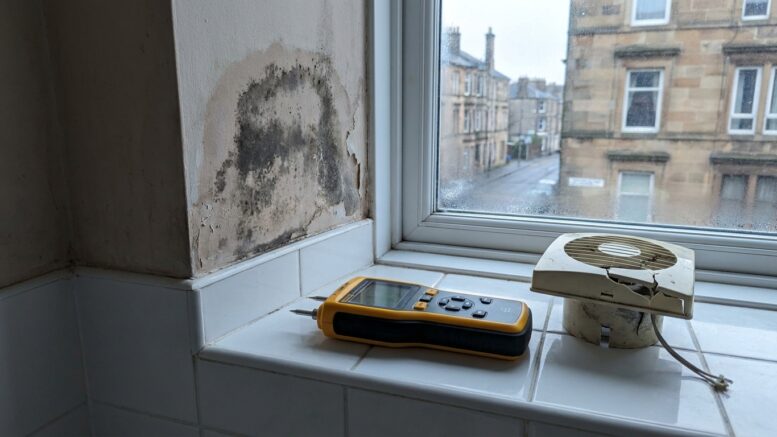
The Scottish Government has issued guidance confirming that private landlords must investigate reports of damp or mould within 10 working days from 6 October 2026, when the Investigation and Commencement of Repair (Scotland) Regulations 2026 take effect.
The guidance sets a three-working-day deadline to give tenants a written summary after an investigation ends. Where substantial damp or mould is found, repair work must begin within five working days. Private landlords must then complete the work within a reasonable time.
Scottish landlords have less than four weeks to make sure their repairs process can record a report, arrange a competent inspection, document the findings and start remedial work. A mould wash on its own will not normally be enough where the underlying cause remains.
Scottish Awaab’s Law guidance sets out the repair timetable
This follows Landlord Knowledge’s October 2025 coverage of Awaab’s Law and private landlord duties, which examined the direction of travel on damp and mould standards. The new Scottish guidance turns that broader policy into a dated operational timetable for reports received from 6 October.
Landlords are expected to use a competent person for the investigation. The Scottish Government says no particular qualification is prescribed, but the person should have the skills and expertise to decide whether a home is substantially free from damp and mould and whether repair work is needed. In-person visits should be the usual approach, unless an alternative is justified.
Landlords should also review their wider repair arrangements. Landlord Knowledge’s guide to landlord repair responsibilities sets out the existing baseline, while the Scottish regulations add specific damp and mould timescales on top of the Repairing Standard.
Damp and mould repairs must tackle the root cause
The five-working-day deadline applies to commencing the repair, not necessarily finishing every job. For a private landlord, completion must follow within a reasonable time after the investigation. The guidance makes clear that a temporary treatment can form part of the response, but it does not remove the need to prevent the problem returning where that is reasonably practicable.
That distinction is likely to be important for common cases involving ventilation faults, water ingress or defects behind fitted units. Keeping a clear trail of the tenant’s report, access attempts, inspection, interim measures and contractor appointments should help show how the landlord responded if a case is challenged.
The official Scottish Government guidance for landlords says the investigation should identify the root cause. Where substantial damp or mould is present, the written summary must name those who carried out the investigation, give the findings, state what work is required and provide a target date for starting it.
Private tenant cases can reach the First-tier Tribunal
The £15 initial compensation and £3 daily payment in the guidance apply to social tenants through Scotland’s Right to Repair Scheme. Private tenants use a different route: they can apply to the First-tier Tribunal for Scotland’s Housing and Property Chamber where they believe the Repairing Standard has not been met.
The Tribunal will take account of whether the landlord met the Awaab’s Law timescales when deciding whether repairs were carried out within a reasonable period. It can make a Repairing Standard Enforcement Order. Failing to carry out repairs required by such an order without a reasonable excuse is a criminal offence; the Tribunal can also restrict rent through a Rent Relief Order until compliance.
The practical warning is that a landlord should not assume a dispute turns on the size of the visible patch of mould. The published guidance directs landlords to assess the cause, the persistence of the issue and the vulnerability of occupants, then explain their decision to the tenant.
What this means for landlords
- If you let property in Scotland: build the 10-day investigation, three-day written-summary and five-day repair-start deadlines into your repairs workflow before 6 October.
- If you use an agent or contractor: agree who logs reports, appoints inspectors and sends the written summary. The landlord remains responsible for the summary.
- Watch for: repeat or spreading mould reports. A significant change or a new location can trigger a new investigation and a fresh timetable.
- Bottom line: document the cause and the response, not only the treatment applied at the first visit.
Editor’s view
Scotland’s guidance is more than a reminder to take damp seriously. It turns repairs handling into a timed compliance process for private landlords. The landlords most exposed will be those relying on informal contractor arrangements with no clear record of who did what and when.
Author: Editorial Team – UK landlord & buy-to-let news, policy, and finance
Published: 14 September 2026
Sources: Scottish Government – Awaab’s Law: guidance for landlords in Scotland
Related reading: Awaab’s Law to enforce faster damp repairs as private landlords face new legal duties