

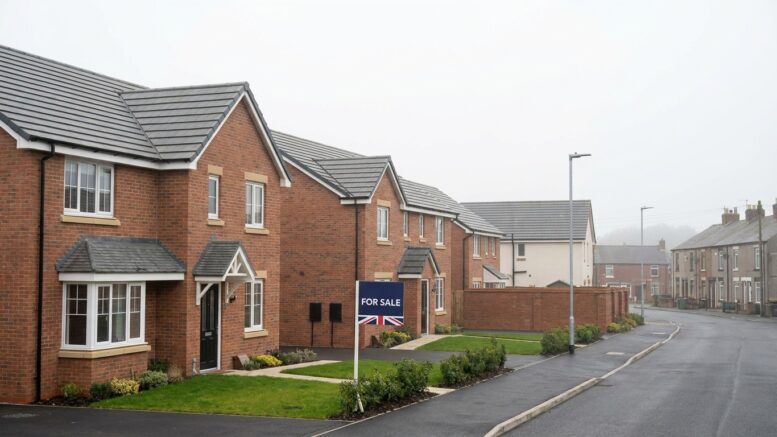
Propertymark says the average asking price of newly instructed new-build homes across Great Britain edged up to £501,658 in July 2026, a modest rise from £500,450 a year earlier.
The headline move was small, but the regional spread was not. The West Midlands recorded the biggest annual increase, with average new-build asking prices up by £33,838 to £418,281, while the East of England saw the sharpest fall, down £18,713 to £505,001.
For landlords and buy-to-let investors, the figures matter because they point to a market where pricing power is becoming more localised. New-build stock is not moving in one direction everywhere, which makes regional selection and exit assumptions more important than broad national averages.
Regional new-build prices are pulling further apart
In Propertymark’s latest housing report and resource library update, the organisation said Scotland, Wales, the East Midlands, North East, North West, South West, West Midlands, and Yorkshire and Humberside all posted annual increases in average asking prices for newly instructed new-build properties.
London, the South East and the East of England moved the other way. London’s average asking price for newly instructed new-build homes fell to £839,100 from £845,866, while the South East slipped to £548,809 from £552,109. The East of England recorded the steepest retreat among the regions in the release.
Nathan Emerson, chief executive of Propertymark, said regional differences were making it harder for some buyers to get on the ladder and that housing policy decisions later this year would be watched closely.
That matters to landlords because new-build pricing affects more than first-time buyers. It feeds into appraisal benchmarks, developer incentives, and the pricing of stock that may later come into the private rented sector through small investors or portfolio acquisitions.
This follows Landlord Knowledge’s recent report on Hamptons data showing many landlord bids are still landing below asking price, which suggested investors remain price-sensitive even where supply has improved. Landlord Knowledge has also covered how build-to-rent starts have fallen sharply, reinforcing the view that future rental supply cannot be taken for granted just because some parts of the sales market look softer.
What the July figures could mean for landlords
The modest national rise should not be read as a blanket green light for new-build investment. In some areas, higher asking prices may simply reflect the mix of schemes coming to market rather than broad-based value growth. Propertymark itself noted that local development location, planning requirements, property type, and material and labour costs can all sway regional averages.
That is the practical point for landlords. A new-build flat in an overheated micro-market is a different proposition from a family house in a lower-cost region where stock is still relatively scarce and yields may stack up better. Investors looking at off-plan or recently completed homes need to stress-test assumptions on resale values, incentives and achievable rents rather than rely on national averages.
There is also a timing issue. With the Autumn Budget due on 28 October, any policy aimed at first-time buyers or development activity could shift demand again before year-end. If incentives are widened, developers may regain some pricing confidence. If affordability remains tight, regional discounts and sales support could become more common.
What this means for landlords
- If you’re comparing regions: focus on local pricing direction, not the small national average rise.
- If you’re buying new-build stock: check whether asking prices are being supported by incentives that may not hold on resale.
- Watch for: Budget measures affecting first-time buyers, development viability and new-home demand.
- Bottom line: the new-build market still looks fragmented, and landlords will need sharper regional judgement than the national headline suggests.
Editor’s view
A flat national increase tells landlords very little on its own. The more useful signal is the widening regional split, because that is where pricing mistakes and buying opportunities are more likely to show up first.
Author: Editorial Team – UK landlord & buy-to-let news, policy, and finance
Published: 19 August 2026
Sources: Propertymark
Related reading: Hamptons: 56% of landlord offers come in 10% below asking price