
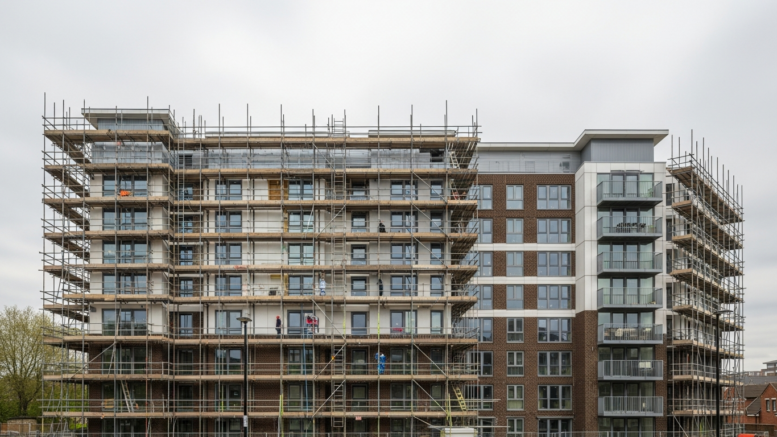
Government remediation data shows 2,080 residential buildings in England with unsafe cladding had still not started or completed works by the end of May, leaving 47% of monitored blocks unresolved.
The latest monthly release from the Ministry of Housing, Communities and Local Government said 4,411 buildings over 11 metres are now being tracked, up by 33 on the month. Just 1,672 buildings, or 38%, had completed remediation works, while another 659 had works underway.
For landlords with leasehold flats in affected blocks, the figures matter because delays can keep sales stuck, remortgages harder to secure, and management costs elevated even where direct remediation funding is available.
Remediation progress is still uneven
The department said 53% of monitored buildings had either started or completed works by 31 May, but that still leaves almost half of known unsafe blocks without a finished outcome. The data also points to a wide gap between places, with Southampton showing the highest completion rate among authorities monitoring more than 100 buildings.
MHCLG’s Building Safety Remediation: monthly data release – May 2026 also put the potential cost of fixing unsafe cladding in England at up to £22.7bn. It said up to £15.2bn is expected to be funded through government programmes, with a further £7.4bn from non-government sources.
That backdrop helps explain why cladding remains a live issue for flat landlords even nine years after Grenfell. Funding routes exist, but the pace of delivery is still slow enough to keep many owners and leaseholders in limbo.
Leasehold landlords still face practical fallout
Karl McArdle, co-founder of The Property Buying Company, said owners worried about a building’s exterior should report it to Homes England and check whether the block could qualify for support through the Cladding Safety Scheme.
He said legally responsible parties may be able to apply for funding where buildings fall within the scheme’s size and location rules, though the process still depends on eligibility checks and building-specific evidence.
This follows Landlord Knowledge’s Grenfell reforms put flat landlords on notice, which highlighted how new building safety rules are adding further compliance pressure for investors with leasehold flats. Combined with Landlord Knowledge’s RICS tightens EWS1 rules for landlords with flats, the latest figures suggest the market is still dealing with both regulatory change and a long remediation tail.
Even where landlords are not paying the full remediation bill themselves, unfinished cladding cases can still drag on valuations, service charges, insurance costs and transaction times. That is particularly relevant for investors trying to refinance or exit a flat in a block that has not yet reached sign-off.
Enforcement pressure is still building
The monthly release also said local authority enforcement action had been, or was being, taken under the Housing Act 2004 against 898 buildings over 11 metres with suspected unsafe cladding as at 22 May, up by 18 on the month.
That creates another risk for landlords and freeholders connected to affected buildings. Where remediation stalls, councils are under pressure to show progress, and enforcement can become part of the route to get works moving.
The slower-moving part of the picture is the Cladding Safety Scheme for 11m-plus buildings. As at the end of May, 1,325 buildings had been assessed as eligible, but only 367 had started or completed remediation works and just 112 had completed them.
What this means for landlords
- If you own a leasehold flat in a taller block: check whether the building’s remediation status could affect refinancing, saleability or service charge forecasts this year.
- Watch for: delays around Cladding Safety Scheme eligibility, local authority enforcement, and missing paperwork that can slow transactions further.
- Bottom line: funding support has widened, but nearly half of monitored unsafe blocks are still unresolved, so cladding risk remains a live investment issue.
Editor’s view
Nearly half of monitored unsafe blocks still sit short of a completed fix, which tells landlords this is not a legacy story that has quietly gone away. Flat investors do not need another reminder that building safety risk can lock up value for years, but these figures show that is still exactly what is happening.
Author: Editorial Team – UK landlord & buy-to-let news, policy, and finance
Published: 29 June 2026
Sources: MHCLG Building Safety Remediation monthly data release May 2026, The Property Buying Company press release
Related reading: Grenfell reforms put flat landlords on notice