

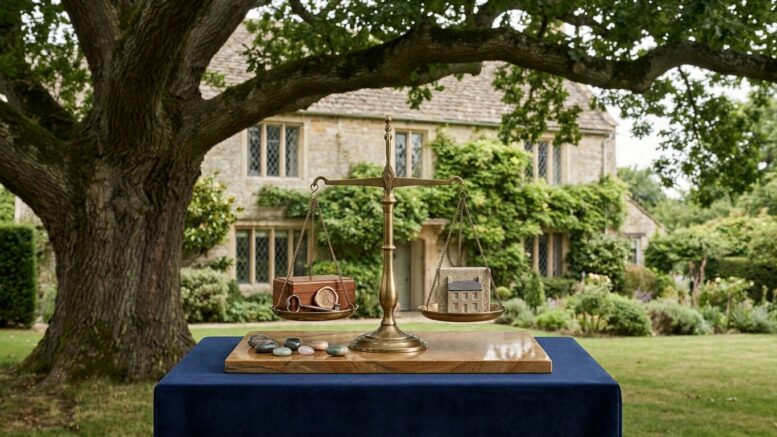
Conservative leader Kemi Badenoch has pledged to remove inheritance tax from family homes passed to children or grandchildren if the Conservatives return to government, and said couples would be able to leave a further £1 million tax-free.
The announcement, made in Badenoch’s 7 October conference speech, is a proposed future policy rather than a change to the tax rules now. The announcement, as reported, does not set out draft legislation, detailed costings or eligibility rules.
That distinction matters for landlords and other property owners. The wording used in the speech is about the family home; it does not establish whether second homes, buy-to-let properties, property held through a company or trust, or mixed estates would be covered.
What Badenoch has proposed
In her Conservative Party Conference speech, Badenoch said: “No stamp duty when you buy your home, no mansion tax when you live in your home, and no inheritance tax on your home when you pass it to your children or grandchildren.”
She also said couples would be able to leave an additional £1 million tax-free to their families. The Conservative proposal would therefore go beyond the current residence-based allowance, but the party has not yet set out how it would define a family home, calculate the exemption or deal with circumstances such as downsizing, multiple residences, jointly owned property, trusts and estates with rental assets.
Current inheritance-tax rules have not changed
Under the current system, most estates have a £325,000 inheritance-tax nil-rate band. A qualifying home passed to direct descendants can also attract the residence nil-rate band, which is currently worth up to £175,000 per person. Unused allowances can in some cases transfer between spouses or civil partners.
The residence nil-rate band tapers for estates worth more than £2 million. That is an estate-value threshold for reducing the current allowance, not a rule that makes a property worth up to £2 million free of inheritance tax. Current eligibility and the interaction between allowances depend on the facts of the estate; owners should use HMRC’s guidance on passing on a home and obtain advice where appropriate.
Nothing in Badenoch’s speech changes those rules today. A landlord considering a sale, transfer, will or ownership restructure should not assume that a buy-to-let property would be exempt under the proposal. Where a plan also involves selling a rental property, Landlord Knowledge’s Capital Gains Tax guide explains the separate sale-tax issues.
Propertymark urges clarity on the detail
Timothy Douglas, Head of Policy and Campaigns at Propertymark, said: “The commitment to remove inheritance tax from the family home will also be welcomed by homeowners and families planning for the future. For many, the family home is their most significant asset, so providing greater certainty around passing it on will be important. The detail will matter, and any changes must be clear, workable and considered alongside the wider taxation and housing policy landscape.”
That final qualification is significant for the private rented sector. An exemption limited to an owner-occupied main home and a broader exemption for property wealth would be very different policies. The published announcement does not yet resolve where a portfolio landlord’s rental property, or a home that has at different times been let and occupied, would sit.
This follows Landlord Knowledge’s April report on HMRC stepping up checks on property values in inheritance-tax cases. It is a reminder that valuations, ownership records and the legal structure of an estate can still matter under the rules currently in force.
What this means for landlords
- Do not treat this as current law: it is an opposition policy pledge, with no change to HMRC’s inheritance-tax rules today.
- Keep buy-to-let assets separate from the headline: the proposal refers to a family home. It does not confirm that a rental property, second home, company-held property or trust-held property would qualify.
- Watch for policy detail: the definition of a family home, any value or estate limits, transition rules and the treatment of jointly owned or mixed-use property will determine the real effect.
- Use the current rules for planning: check HMRC guidance and take regulated legal or tax advice before changing a will, ownership share or sale timetable.
Editor’s view
The headline should not be reduced to an inheritance-tax exemption for a “£2 million property”. That is not the policy announced: £2 million is already relevant to the taper of the current residence nil-rate band, while Badenoch’s speech described an exemption for a family home and a separate £1 million allowance for couples.
For landlords, the unanswered question is where rental assets would fall once the detail is published. Until then, this is a political commitment about family homes, not an estate-planning rule for a buy-to-let portfolio.
Author: Editorial Team – UK landlord & buy-to-let news, policy, and finance
Published: 8 October 2026
Sources: The Guardian’s report of Kemi Badenoch’s conference speech, HMRC guidance on passing on a home, Propertymark statement, 7 October 2026
Related reading: HMRC steps up checks on property values in IHT cases