

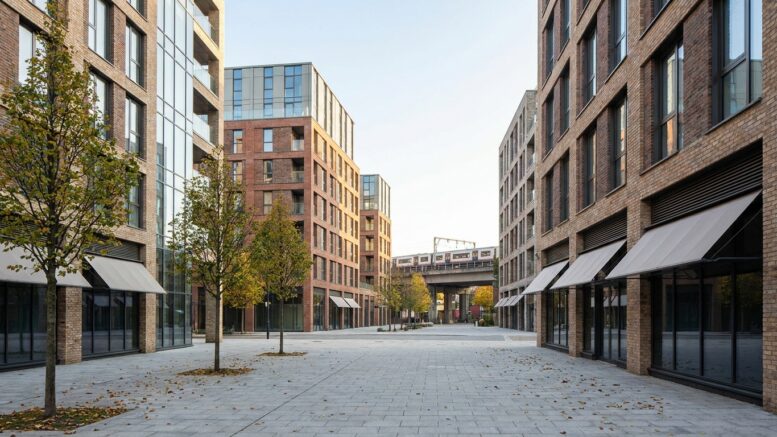
NRLA Living and Bidwells say Build to Rent delivered an average 61 percent of new homes across eight UK regeneration areas over the past decade, despite representing less than 2 percent of national housing stock.
The research, released on 17 September, puts the BTR share at 87 percent of homes built in both Stratford, London, and Redcliff, Bristol. It was 73 percent in Milton Keynes Central and 66 percent at Blackhorse Lane in Waltham Forest.
The figures arrive as institutional capital, councils and private landlords are all competing for a place in the next phase of rental supply. They do not mean BTR can replace buy-to-let, but they show where large-scale rental schemes have become a major part of local delivery rather than a niche add-on.
BTR has a concentrated role in regeneration
The eight projects in the NRLA Living and Bidwells study were selected because BTR had a leading role in their regeneration. That matters when reading the 61 percent average: it is not a national estimate of all housebuilding, nor proof that every regeneration scheme will produce the same result.
Within those locations, the report says BTR has helped put residents into new areas early enough to support the shops, cafes and services that follow. It also found that BTR-led regeneration areas attracted, on average, five times as many people aged 20 to 39 as other local-authority areas.
The claim is strongest as a description of the selected schemes, not a guarantee of rental demand or investment returns. Rent levels, planning obligations, transport links, employment and the quality of management still decide whether a particular development works for tenants and investors.
Buy-to-let remains part of the supply picture
Landlord Knowledge’s report on Lloyds Living’s 182-home rental deal showed how major institutions are expanding their direct exposure to rented housing. The NRLA research adds local delivery data to that trend, but its authors also argue that BTR should complement, rather than displace, ordinary buy-to-let.
That distinction is important. BTR investors typically fund and manage purpose-built schemes at scale, while small and medium landlords provide homes in existing streets and smaller blocks. A healthy rental market needs both routes, particularly where one new development cannot provide the full range of locations, property types or tenancy options tenants need.
The report follows earlier concern about the sector’s economics. Landlord Knowledge’s coverage of John Lewis leaving Build to Rent illustrated that institutional delivery is not insulated from financing, tax and operating pressures. A high share of construction in a few regeneration areas therefore should not be confused with an easy national business case.
The NRLA Living and Bidwells research summary says the schemes examined can give councils and investors a clearer basis for judging BTR’s place in the housing mix. The underlying report is not published in full, so the figures should be treated as the organisations’ analysis of those eight sites.
What this means for landlords
- If buying near a regeneration scheme: check planned BTR supply alongside local rents, tenant demand and competing stock before assuming a new neighbourhood will lift returns.
- Watch for: planning approvals, transport links and commercial space, which can affect a scheme’s appeal more directly than a headline construction share.
- If you own nearby: compare the management, amenity and tenancy offer from BTR operators with the service a smaller landlord can realistically provide.
- Bottom line: BTR is a powerful local delivery tool in selected areas, but it works alongside buy-to-let rather than making local research unnecessary.
Editor’s view
These figures are a useful correction to the idea that BTR is only a London investment story. The sharper lesson for landlords is local: a large rental scheme can change the standard of competition, but it cannot substitute for sound demand, good transport and disciplined buying.
Author: Editorial Team – UK landlord & buy-to-let news, policy, and finance
Published: 21 September 2026
Sources: NRLA Living, Bidwells
Related reading: Lloyds Living agrees 182-home rental deal














Be the first to comment on "NRLA: BTR delivers 61% of homes in eight regeneration areas"