
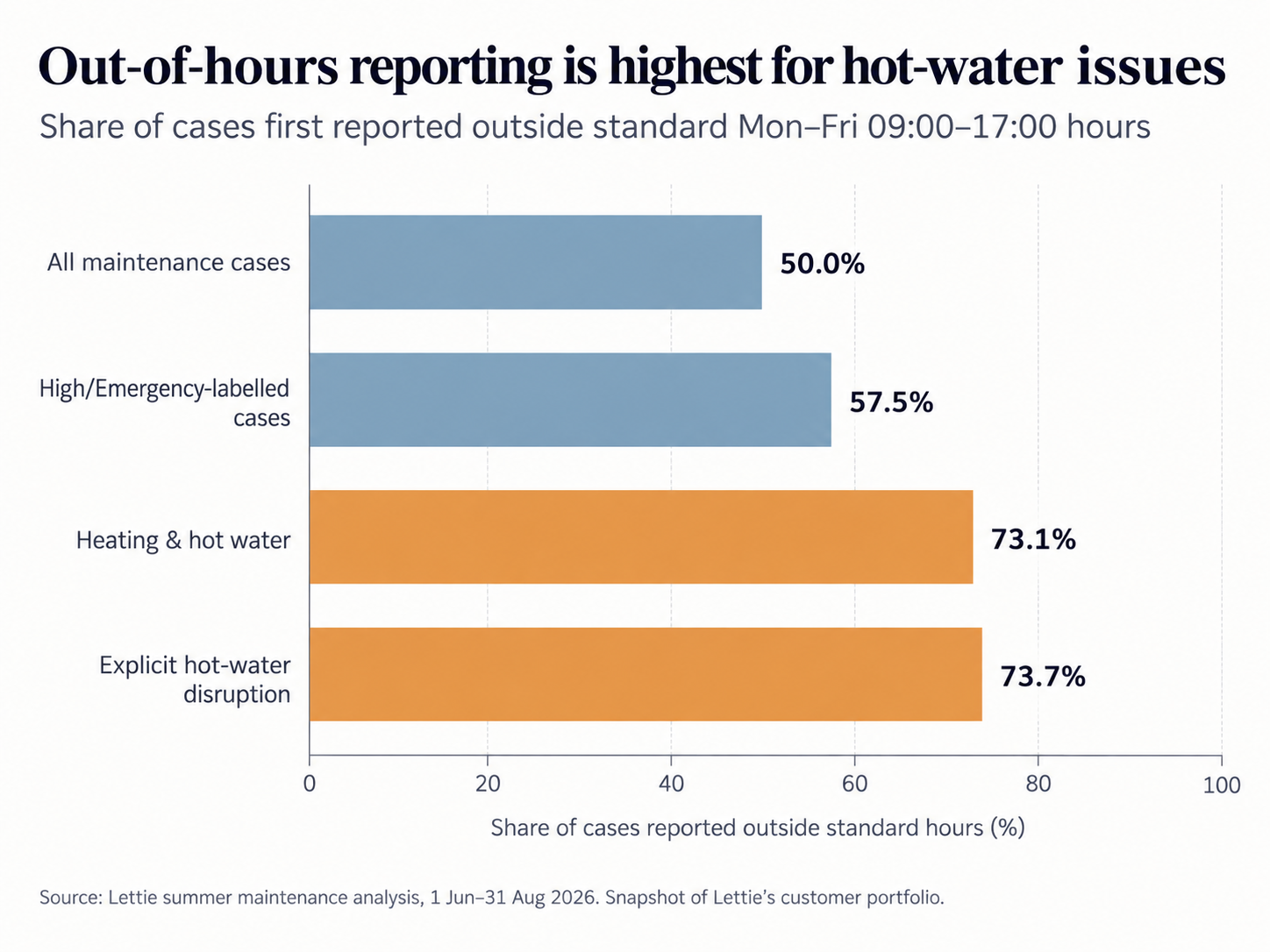
Lettie has found that 73.7 percent of tenant reports involving an explicit hot-water disruption were first raised outside standard Monday-to-Friday office hours during the summer.
The maintenance platform’s analysis also found that half of all cases in its sample were first logged outside the usual 9am-to-5pm working day, while 57.5 percent of cases labelled High or Emergency were reported out of hours.
For landlords, the immediate issue is not that every evening report requires an emergency contractor. It is whether the report can be captured, assessed and routed quickly enough to distinguish a loss of hot water, an active leak or a safety concern from work that can reasonably wait. A tenant who cannot report a problem clearly when an office is shut is less likely to provide the detail needed for a proportionate response.
Hot-water cases have the strongest out-of-hours pattern
Lettie analysed maintenance cases created between 1 June and 31 August 2026 across a customer portfolio supporting more than 10,000 tenants. Heating and hot-water cases were already heavily weighted towards out-of-hours reporting at 73.1 percent. The narrower group of reports explicitly recording hot-water disruption reached 73.7 percent.
That timing matters because loss of hot water can affect a tenant’s use of a home even when the correct next step is not immediately obvious. Landlords should have a clear route for recording the issue, checking whether there is a wider safety or leak risk, and setting out when the tenant will hear what happens next. Landlord Knowledge’s maintenance triage guide sets out why the reported symptoms, urgency and available evidence should be recorded before a repair category is chosen.
Connor Hawkins, chief solutions officer at Lettie, said the figures showed that maintenance demand could not be treated as an occasional exception after 5pm. He said landlords and agents needed a way to capture the problem, understand its urgency and decide what should happen next regardless of when a tenant made contact.
Plumbing still accounts for the largest share of cases
Plumbing and drainage made up 21.6 percent of all summer cases, the largest single category in the analysis. Doors, windows and access accounted for 12.8 percent, followed by heating and hot water at 11.9 percent and appliances and ventilation at 11.5 percent. Combined, plumbing/drainage and heating/hot water represented 33.5 percent of the sample.
This follows Landlord Knowledge’s guide to landlord repair responsibilities, which explains that the practical response depends on the issue, the tenancy and the condition of the property. A summer snapshot cannot decide an individual landlord’s legal duty or timescale, but it is a useful warning against designing repair reporting around office hours alone.
The data is drawn from Lettie’s own customer portfolio, rather than a national survey of all rented homes. It should therefore be read as evidence of reporting patterns within that sample, not a measure of the national frequency of every repair type. The company’s maintenance platform says it supports maintenance reporting, evidence gathering and contractor coordination for landlords and letting agents.
What this means for landlords
- If a tenant reports a hot-water problem: make sure the reporting route collects enough detail to establish whether there is a leak, safety concern or loss of an essential service.
- Before relying on an out-of-hours contact channel: set clear expectations on acknowledgement, escalation and the information tenants should provide.
- For managed portfolios: keep a record of reports, photographs and prior works so the person assessing the case is not starting without context.
- Watch for: recurring plumbing and heating reports, which may point to a wider defect rather than isolated call-outs.
- Bottom line: an effective response starts with a usable reporting route, not simply an emergency contractor’s number.
Editor’s view
Out-of-hours reporting is not the same thing as out-of-hours attendance. But a landlord who cannot receive a clear report until the next working day has already made it harder to judge the response. The hot-water figure is a practical prompt to test that first step before the colder months arrive.
Author: Editorial Team – UK landlord & buy-to-let news, policy, and finance
Published: 15 September 2026
Sources: Lettie summer maintenance analysis, 1 June-31 August 2026
Related reading: Maintenance Triage for Landlords: How to Prioritise Repair Requests