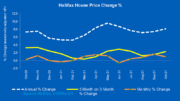


UK rent growth cooled to its lowest level since spring 2022 at the end of last year, while house prices quietly regained momentum. New figures published today show average private rents rising more slowly across most regions, even as landlords continue to grapple with higher costs and regulatory change.
According to data released by Office for National Statistics, average monthly private rents rose by 4.0% in the year to December 2025, taking the typical rent to £1,368. That is £52 a month more than a year earlier, but down from 4.4% growth in November.
At the same time, average house prices increased by 2.5% in the year to November, pushing the typical property value to £271,000 as the market headed into 2026.
Rent growth outlook remains uneven for landlords
While headline rent growth is slowing, the picture for landlords varies sharply by region. In England, average rents rose 3.9% over the year to December, but the North East continued to see the strongest inflation at 7.9%. London, by contrast, recorded annual growth of just 2.1%, with the average rent still the highest nationally at £2,268 a month.
Wales saw rents climb 5.7% to £822, while Scotland recorded a more modest 2.8% increase to £1,018 – the lowest annual rise there for more than four years. Northern Ireland, now fully included in the ONS rental index, also saw growth slow to 5.7%.
For landlords, that cooling should be treated with caution. The ONS index captures the entire stock of rented homes, meaning rent increases on new lets can take months or years to feed through. In practice, many landlords report that re-letting still delivers sharper uplifts than in-tenancy increases, especially in undersupplied local markets.
Nathan Emerson, chief executive of Propertymark, warned that demand continues to outstrip supply. He said rental inflation may be easing, but “the rental market continues to suffer from a chronic undersupply of properties versus actual demand”, adding that new legislation and complex tax changes are weighing heavily on landlord confidence.
House prices and buyer confidence show cautious improvement
House prices, meanwhile, have shown a steadier rhythm. In England, average values rose 2.2% year on year to £293,000, while Scotland saw stronger growth of 4.5%. Northern Ireland recorded the fastest increase, with prices up 7.1% over the year to the third quarter of 2025.
Emerson pointed to improving transaction levels, noting around 82,000 more property transactions last year compared with the year before. That, he said, reflects “growing consumer confidence and affordability in many regions”, although inflation risks could delay further base rate cuts.
From a lending perspective, Adrian Moloney of OSB Group said affordability remains stretched but could improve if funding costs continue to fall. “There is a genuine opportunity for an affordability turning point in 2026,” he said, with brokers playing a central role in helping borrowers make the numbers work.
Specialist finance for landlords under regulatory pressure
The bigger story sits beneath the surface for landlords. Alex Upton, managing director at Hampshire Trust Bank, said slowing rental growth does not remove the underlying imbalance between supply and demand.
He pointed to the cumulative impact of the Renters’ Rights Act, tax changes and funding costs, prompting many landlords to restructure portfolios, move into limited companies or diversify into mixed-use assets. In that environment, specialist lenders and brokers are becoming increasingly important in helping landlords secure flexible, long-term funding.
Nick Leeming, chairman of Jackson-Stops, added that greater fiscal clarity towards the end of 2025 helped steady confidence. With further base rate cuts from the Bank of England expected over the year ahead, buying power should gradually improve into 2026.
Editor’s view
Slower rent growth may make for calmer headlines, but it does little to ease the structural pressures facing the private rented sector. Supply remains tight, costs remain high, and policy uncertainty continues to shape landlord behaviour. The question for 2026 is not whether rents cool further, but whether enough investors feel confident enough to stay in the market to prevent an even deeper shortage.
Author: Editorial team – UK landlord & buy-to-let news, policy, and finance.
Published: 21 January 2026
Sources: Office for National Statistics; Propertymark; OSB Group; Jackson-Stops; Hampshire Trust Bank
Related reading: UK house prices: early buyer demand beats January norms, says Berkeley bosss