

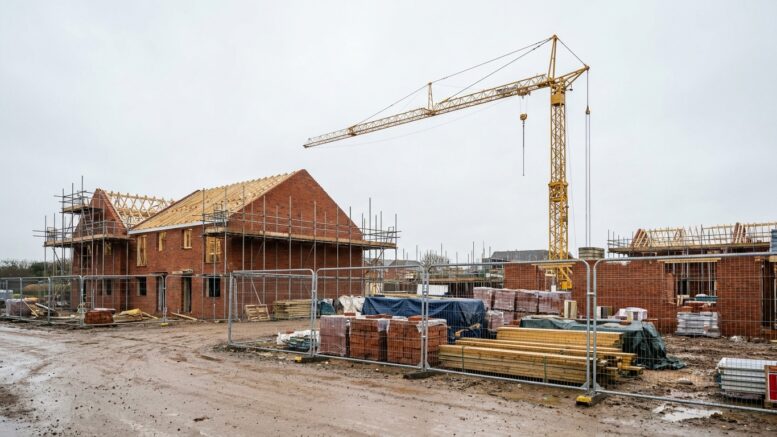
Residential construction starts fell 36 percent year on year in the three months to the end of August, Glenigan has reported, as developers reassessed site viability against weak sales, higher build costs and the forthcoming building safety levy.
The September Construction Index also recorded a 15 percent fall from the preceding three months. Private housing starts were down eight percent over that period and 37 percent from a year earlier, while social-housing starts fell 29 percent quarter on quarter and 30 percent annually.
A smaller pipeline of new homes is a current issue for landlords, not just a housebuilding statistic. If fewer schemes start now, less stock can reach the sales and rental markets later, particularly in places where demand is already running ahead of available homes.
Site viability holds back new housing
Glenigan said its Index covers underlying projects worth less than £100 million. Across all sectors, the value of work starting on site fell two percent from the previous three months and stood 20 percent below the equivalent period in 2025. Non-residential activity rose six percent quarter on quarter, leaving housing as the weakest major part of the market.
Allan Wilen, economics director at Glenigan, said the freefall in construction had halted but activity remained low. He said residential was continuing to drag on the overall market as developers weighed site viability against higher construction costs and the looming levy.
The figures point to a commercial block that planning permissions alone cannot solve. A scheme can have land and consent in place, yet still remain on hold if sales values, finance costs and building costs leave too little margin to begin construction.
Regional divides could shape future rental pressure
The national decline was not evenly spread. The North West recorded a 46 percent rise in overall project starts over the three-month period and stood eight percent above a year earlier, while Yorkshire rose 43 percent and remained 11 percent ahead. The South East, by contrast, fell 29 percent quarter on quarter and 43 percent annually, and the West Midlands declined 18 percent and 41 percent respectively.
Those differences matter for buy-to-let decisions because local supply conditions can move in the opposite direction to the UK headline. A landlord assessing an acquisition should look at the homes actually expected to reach a local market, not assume a national slowdown will affect every town in the same way.
This follows Landlord Knowledge’s April report on a 30 percent fall in residential starts. The latest data shows the housing pipeline has not recovered over the summer, and the annual decline has worsened to 36 percent.
Landlord Knowledge has also tracked a sharp drop in build-to-rent starts. Private housebuilding and purpose-built rental schemes are not interchangeable, but both figures indicate that new supply is struggling to get from planning and funding into construction.
The full September Glenigan Index notes that office, industrial and health projects performed better than housing. For landlords, that contrast is a warning that the issue is not a blanket halt in construction; it is the economics of building homes at a time when demand for them remains high.
What this means for landlords
- If you are buying: assess local development pipelines as well as current listing levels, particularly where starts are falling sharply.
- Watch for: whether weak site viability feeds through into fewer completions and higher competition for rental homes over the next one to two years.
- Bottom line: a thin housing pipeline may support demand, but it is not a healthy substitute for more homes reaching the market.
Editor’s view
Falling starts are an early warning, not a landlord windfall. Restricted supply can support rents in the short term, but it also deepens affordability pressure and invites a more interventionist political response. A durable rental market needs viable development as well as well-run existing stock.
Author: Editorial Team – UK landlord & buy-to-let news, policy, and finance
Published: 11 September 2026
Sources: Glenigan
Related reading: Savills: BTR starts plunge 79% as pipeline keeps shrinking