
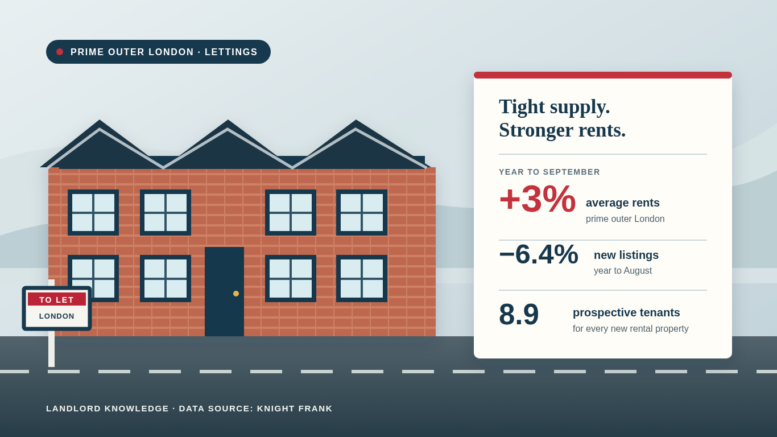
Knight Frank says average rents in prime outer London rose 3 percent in the year to September, as new lettings listings fell 6.4 percent and competition reached 8.9 prospective tenants for every new rental property.
The agency’s latest London lettings update also records a 2.3 percent rise in prime outer London rents over the past six months – its fastest half-year increase since January 2024. In prime central London, rents rose 1.3 percent over the year and 1.8 percent in six months, while the tenant-to-property ratio reached a four-year high of 5.6.
London landlords deciding whether to hold, re-let or buy before the 28 October Budget have a sharper local signal than the headline annual figures alone provide. The data points to tight stock and fast-moving demand in the prime outer market, but it also reflects a narrow, higher-value segment rather than the whole capital.
Rental supply falls as tenant competition builds
Knight Frank attributes part of the pressure to landlords setting higher asking rents after the Renters’ Rights Act took effect in May, alongside higher borrowing costs and growing pre-Budget tax speculation. Its figures describe asking rental values in its prime London market, not rents agreed across all London tenancies.
Prime outer London was the tighter of the two segments. The 8.9 tenant-to-property ratio for the three months to September was above the level seen when demand bounced back after pandemic restrictions. The 6.4 percent fall in new listings compares the year to August with the previous 12 months, so it should not be read as a one-month change in available homes.
This follows Landlord Knowledge’s September report on sharply higher prime London house rents, which covered a separate Beauchamp Estates measure of large-house rents. Knight Frank’s latest update adds a different warning: the pressure is now visible in the flow of new listings and the number of prospective tenants per property.
That distinction is useful for landlords. A stronger asking-rent series can improve the case for a realistic review at renewal, but it does not remove the need to test comparable achieved rents, tenant affordability and likely void time. Landlords should also keep the new rent-review rules in mind; Landlord Knowledge has reported that many landlords initially planned to hold rents after the Renters’ Rights Act, rather than rely on a single national response.
Prime central London shows a different supply picture
Prime central London was less constrained by supply, according to Knight Frank, because weaker sales conditions encouraged more discretionary owners to let their homes. Even so, the 1.8 percent rise in the past six months was the fastest half-year increase since January 2024.
The contrast matters for any landlord treating “prime London” as one market. Prime outer London recorded stronger annual rent growth and a much tighter demand ratio, while central London had more stock but still saw rents accelerate over the latest six months. The figures do not show that every local area can support the same increase.
Knight Frank also puts the update against a changing cost backdrop. It says the average five-year fixed buy-to-let mortgage at 75 percent loan-to-value was 4.7 percent in August, up from 3.88 percent in January. That may be material for a highly geared owner, but a rent decision still needs to stand up against comparable local evidence and the tenancy’s formal review process.
Landlords should therefore view the release as a demand-and-supply indicator, not a pricing instruction. The primary Knight Frank research update gives the latest prime-market measures, but its data cannot establish the same result for every borough or property type.
What this means for landlords
- If you are re-letting in prime outer London: compare your proposed rent with recent achieved local lets and the 8.9 tenant-to-property ratio, rather than relying only on annual averages.
- If you hold central London stock: check local availability first. Knight Frank says supply is less constrained there, even though rents have accelerated over six months.
- Watch for: the 28 October Budget and any effect on buyer, seller and landlord decisions before committing to a sale or long fixed mortgage.
- Review the paperwork: use the correct Renters’ Rights Act rent-review route and keep evidence supporting the proposed figure.
- Bottom line: tight prime outer London supply strengthens demand, but the evidence is segment-specific and does not justify a blanket London rent rise.
Editor’s view
Prime London data often attracts attention because the numbers are large. The more useful signal here is the gap between outer London supply and demand: landlords with genuinely scarce, well-presented homes may have pricing power, but a weak comparable-rent case will still be exposed under the new rules.
Author: Editorial Team – UK landlord & buy-to-let news, policy, and finance
Published: 05 October 2026
Sources: Knight Frank
Related reading: Beauchamp: prime London house rents jump 67%
📘 Renters’ Rights Act: Complete Landlord Guide
Everything you need to know about the new rules – 1 May 2026