

Prime rents rose again in the second quarter of 2026, with Savills saying landlords are increasing asking levels to offset higher borrowing costs, tax pressure and the operational impact of the Renters’ Rights Act.
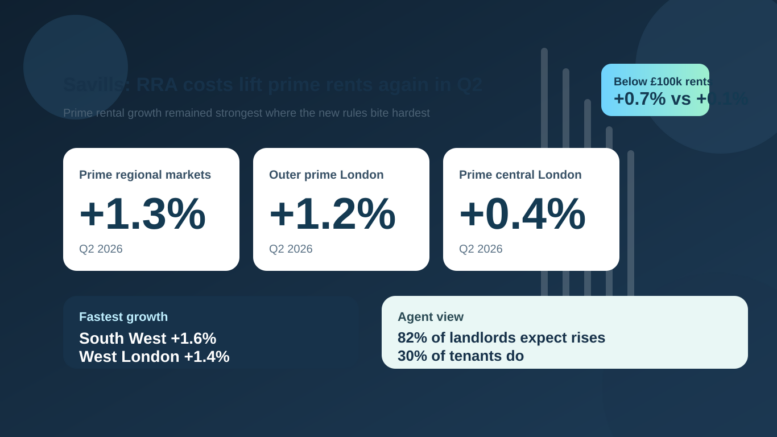
The agency’s latest indices show values climbed 1.3 percent across prime regional markets and 1.2 percent in outer prime London during Q2, while prime central London recorded slower quarterly growth of 0.4 percent. Savills also says rent growth was strongest in markets most affected by the new rules, especially homes that fall within the Act’s scope.
For landlords, that matters now because it points to a market where compliance pressure and reduced willingness to let are still feeding through into pricing. The headline is not just that rents are up. It is that regulation and cost pressure are still being passed into the market where stock is tight enough to allow it.
Where rent growth is strongest
Savills says the South West led quarterly growth at 1.6 percent, with West London at 1.4 percent. In prime central London, homes below the £100,000 annual rent threshold rose 0.7 percent in Q2, against 0.1 percent for higher-value properties. That is one of the clearest early signs yet that the Renters’ Rights Act is having a sharper pricing effect in parts of the market sitting directly inside the new framework.
The firm also found a sharp gap between landlord and tenant expectations. Around 82 percent of Savills agents in London said landlords expected rents to increase, compared with just 30 percent of tenants.
That gap matters because it hints at a tougher second half of the year for re-lets and renewals. Tenants may be more price-sensitive than landlords expect, even where supply remains thin. Landlord Knowledge previously reported on prime London rents returning to growth, but the latest Savills release adds a more direct post-RRA explanation for why those increases are holding.
RRA pressure is feeding into pricing
Savills says almost half of its London agents and 71 percent of agents outside the capital now see the Renters’ Rights Act as landlords’ biggest concern, with the loss of Section 21 cited most often. That is important because it ties rent moves to landlord behaviour, not just seasonal demand.
This follows Landlord Knowledge’s recent report on Foxtons’ warning that the RRA had already hit student lettings revenue. The latest Savills data points in the same direction from a different angle: where landlords stay in the market, many are trying to reprice for higher risk and tighter margins rather than absorb the extra cost.
There is also a warning buried inside the figures. Prime central London only managed 0.4 percent quarterly growth, and Savills says tenants are becoming more selective. So while the market can still carry higher rents in parts of the country, landlords should not assume every property can simply be pushed up without resistance.
What this means for landlords
- If you own in stronger prime or commuter markets: there may still be room to review rents, but only where pricing stays credible against current local stock.
- Watch for: whether other agents start reporting the same RRA-driven split between sub-£100,000 homes and the top end of the market.
- If you are refinancing: higher mortgage costs are still being cited as a reason landlords are trying to lift rents.
- Practical step: benchmark any increase against live competing listings, not last year’s achieved rent.
- Bottom line: the market is still supporting rent growth, but only selectively, and regulation is part of the reason.
Editor’s view
What stands out here is not the size of the quarterly rise but the explanation behind it. Landlords are not lifting rents in a vacuum – they are trying to price in a more regulated and more expensive version of the business.
Author: Editorial Team – UK landlord & buy-to-let news, policy, and finance
Published: 29 July 2026
Sources: Savills prime rental indices Q2 2026
Related reading: Prime London rents return to growth as sales stay weak