

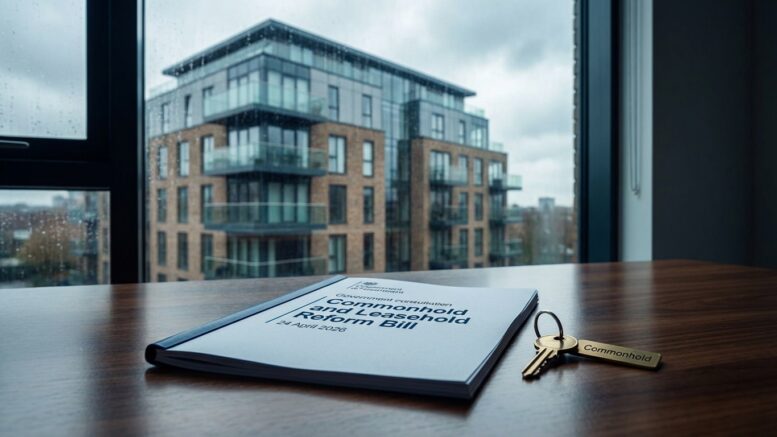
Landlords who invest in flats are being urged to respond to a government consultation that could ban leasehold ownership for all new-build apartments in England and Wales.
The Ministry of Housing, Communities and Local Government launched the consultation on 27 January, seeking views on making commonhold the default tenure for new flatted developments. Responses are open until 24 April 2026.
Commonhold to replace leasehold
Under the proposals, leasehold would no longer be permitted for new-build flats, conversions, or repurposed buildings. Instead, buyers would own their homes outright through commonhold, with no time limit on ownership and collective control over building management.
The consultation accompanies the draft Commonhold and Leasehold Reform Bill, which was published on 4 February and is now undergoing pre-legislative scrutiny by the Housing, Communities and Local Government Select Committee.
Matthew Pennycook, Minister of State for Housing and Planning, said the reforms were central to ending what he described as the “feudal leasehold system” within this parliament.
“Reinvigorating commonhold is integral to achieving that objective,” he said. “At the heart of the commonhold model is a simple principle: the people who should own buildings, and who should exercise control over their management, shared facilities and related costs, are not third-party landlords, but the people who live within them.”
What it means for landlords
For buy-to-let investors, the shift raises questions about future acquisition strategies. Landlords purchasing new-build flats after the ban takes effect would hold them under commonhold rather than leasehold, giving them a share of control over building management decisions alongside other owners.
The government has acknowledged that some exemptions may be necessary where commonhold proves impractical. The consultation asks for views on where leasehold structures should remain, what transitional arrangements are needed, and how long the market will require to prepare.
The proposals follow earlier leasehold reforms introduced through the Leasehold and Freehold Reform Act 2024, which capped ground rents at £250 per year for existing leaseholders and removed the two-year qualifying rule for lease extensions.
Industry bodies have broadly welcomed the direction of travel, though concerns remain about implementation timelines. Landlords holding existing leasehold properties would not be directly affected by the ban, though future reforms could encourage or incentivise conversion to commonhold.
The consultation covers scope, exemptions, timing and transitional arrangements. Responses can be submitted via the government’s Citizen Space portal or by email to [email protected].
Editor’s view
This is a generational shift in how flat ownership works in England and Wales. For landlords, commonhold removes the uncertainty of diminishing lease terms but adds the complexity of collective decision-making with owner-occupiers. The real question is timing – and whether developers will slow delivery while the market adjusts.
Author: Editorial team – UK landlord & buy-to-let news, policy, and finance
Published: 11 February 2026
Sources: Ministry of Housing, Communities and Local Government
Related reading: UK ground rent cap confirmed as leasehold reform hits landlords