

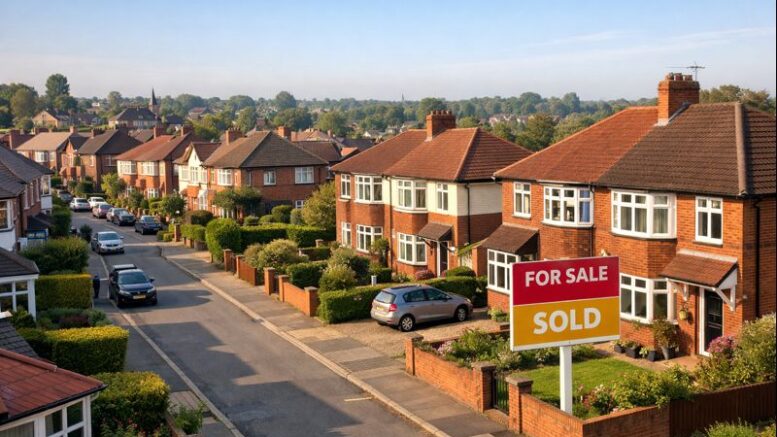
UK house prices rose by 1 percent annually in January 2026, recovering from a year-end dip as improved affordability and lower mortgage rates supported buyer demand. For landlords, the data points to a market stabilising after months of post-Budget uncertainty.
Nationwide’s latest House Price Index shows the average UK property is now worth £270,873, up 0.3 percent month on month after seasonal adjustment. The annual growth rate improved from 0.6 percent in December, suggesting the drag from the Autumn Budget has begun to fade.
Affordability eases for buyers and investors
The headline figures mask a more significant shift: affordability is improving across most of the UK. Nationwide’s benchmark calculation shows a buyer on the average UK income purchasing a typical first-time buyer property with a 20 percent deposit would now spend 32 percent of take-home pay on mortgage payments.
That figure is only slightly above the long-run average of 30 percent and well below the 38 percent peak recorded in 2023 when interest rates spiked. For landlords modelling acquisitions, tighter affordability constraints had been a barrier to entry in recent years – conditions that are now easing.
London saw the largest improvement in affordability over the past year, driven by relatively weak house price growth combined with solid earnings gains and falling rates. The capital remains the least affordable region by a wide margin, but the direction of travel favours investors willing to look beyond prime central locations.
Regional picture offers selective opportunities
Affordability pressures remain most pronounced in southern England, where mortgage costs still consume a larger share of income. By contrast, the North, Yorkshire and The Humber, and Scotland now sit slightly below their long-run affordability averages, creating potential entry points for yield-focused landlords.
Nationwide noted that first-time buyer activity edged higher as a share of total purchases over the past year, suggesting a healthier pipeline of eventual movers into the rental market as circumstances change.
The lender expects housing market activity to recover further in the coming quarters, provided the affordability trend holds. Mortgage approvals remain close to pre-pandemic levels, indicating that finance availability is not the constraint it was during the rate shock of 2022–23.
Editor’s view
A 1 percent annual rise won’t set pulses racing, but stability matters more than momentum right now. Landlords burned by rate rises and regulatory change finally have a market where the numbers are moving in a friendlier direction. The question is whether confidence returns quickly enough to offset the supply gap – or whether caution keeps investors on the sidelines while others act.
Author: Editorial Team – UK landlord & buy-to-let news, policy, and finance
Published: 3 February 2026
Sources: Nationwide House Price Index January 2026
Related reading: UK property transactions hold firm into 2026